Not liking parties
A beginners' guide to the Social (SO) Instinct

Quick announcement before we get started on the Social Instinct!
There is a free-of-charge, interactive Wisdom of the Enneagram gathering every Second Tuesday of the month. All welcome. Diarise these and the Community of Practice sessions on the last Saturday of each month here:
Recordings and key slides are here within a day or two after the gathering.
Ok, SO, let’s jump in…
If you have hung around with Enneagram people who know even a tiny bit more than the quirks of the Nine Types you will probably have heard them talk about their Dominant, Middle and Blind instincts. “I’m a Social Nine”, someone might say.
Why does this detail matter?
The Instincts are absolutely foundational to understanding our intrapersonal and interpersonal dynamics.
Our Enneagram Type is an instinct management strategy.
That sentence comes from the work of John Luckovitch and is worth reading 10 times.
Is “Social Dominant” being an extrovert?
The first misunderstanding to clear away is that Social Dominant indicates extroversion or being a good person who cares about others. SO Dom is not a measure of EQ or interpersonal skills.
In truth, any time any Instinct is Dominant, it means that we have a conditioned preoccupation with that “instinctual territory”, as Helen Palmer describes it. Our Dominant instinct actually represents a somewhat distorted perspective that ends up being painfully self-defeating.
“The insanity of the personality is trying to make an impossible scheme work. We spend our whole lives trying to make it work and enlist other people to help us make it work.”
- Enneagram Personality Types, Inc. 2007, 2023.
When DOMINANT (Distorted, unbalanced, fixated) the Social instinct includes a fixation on ………….. and here comes an Enneagram bingo list….. belonging, status, being admired and followed, having recognised authority, understanding politics and power dynamics, getting along with everyone, being dutiful and conscious of norms and rules, being seen to be a good person, a hunger for applause, being seen as special, valuable or interesting, or on being well networked, being safe and secure, and/or on having power and influence in relationships and relational ecosystems.
What is included in “SOCIAL”, according to the Enneagram?
Russ Hudson surfaces three “Zones” in each Instinct. The SO three zones are:
Reading the room
Maintaining healthy relationships
Contributing and participating
Let’s find out what healthy and in balanced looks like in each of them.
1. Reading the Room:

When balanced, or healthy, this Zone is about being able to sense, with accuracy and in a state of relative inner ease:
How do people feel about each other?
What are the unspoken norms and interpersonal dynamics in this relational field?
What do people need?
Is it psychologically safe for people to be authentic, vulnerable and honest?
How can I contribute to the health, safety and wellbeing of this relational field?
How do I build trust and rapport with people who are unlike myself?
How often is all this true for you?
If very seldom, you may be SO Dominant, or SO repressed/ blind (that is, not balanced, or “present” to this instinct).
2. Maintaining Relationships:
This Zone, when healthy, or balanced, is about a focus on nurturing and sustaining connections with others, including 1:1 relationships. Some people think that healthy one-to-one relationships fall within the “SX”, “Intimate”, or “1:1” Instinct, but they don’t.
“1:1” is a very misleading name. SX has to do with charge, chemistry, sexuality (as the word SX implies, and interpersonal seduction and “transmitting” (see Mario Sikora) or displaying, attractive qualities. See previous article about SX here.
When SO is balanced in the zone of “maintaining relationships”.
Valuing communication with others for its own sake
Treating people as people and not a means to an end or insignificant
Cultivating reciprocity in showing your care and valuing of people
Staying connected and communicating openly and authentically
Actively working on one’s integrity and on being a trustworthy, reliable, and caring person.
How often is all of this true for you?
If very seldom, you may be SO Dominant, or SO repressed/ blind.
3. Contributing and Participating:
The emphasis here is on actively engaging in social groups and contributing to collective efforts.

When balanced
Considering the collective, including others’ feelings, priorities, views, differences and preferences in decision-making
Participating and collaborating with others in activities that we find valuable and important
Creating community and meaning for self and others
Consciously creating safety, belonging, inclusion and connection
A felt experience of the universality of human experience and feeling compassion, solidarity and human bondedness with others
A consciousness of the collective and issues of social justice, equality, human rights and social wellbeing.
How often is this balanced ease true of your experience?
If extremely seldom, you may be SO Dominant, or SO repressed/ blind.
Overall Summary:
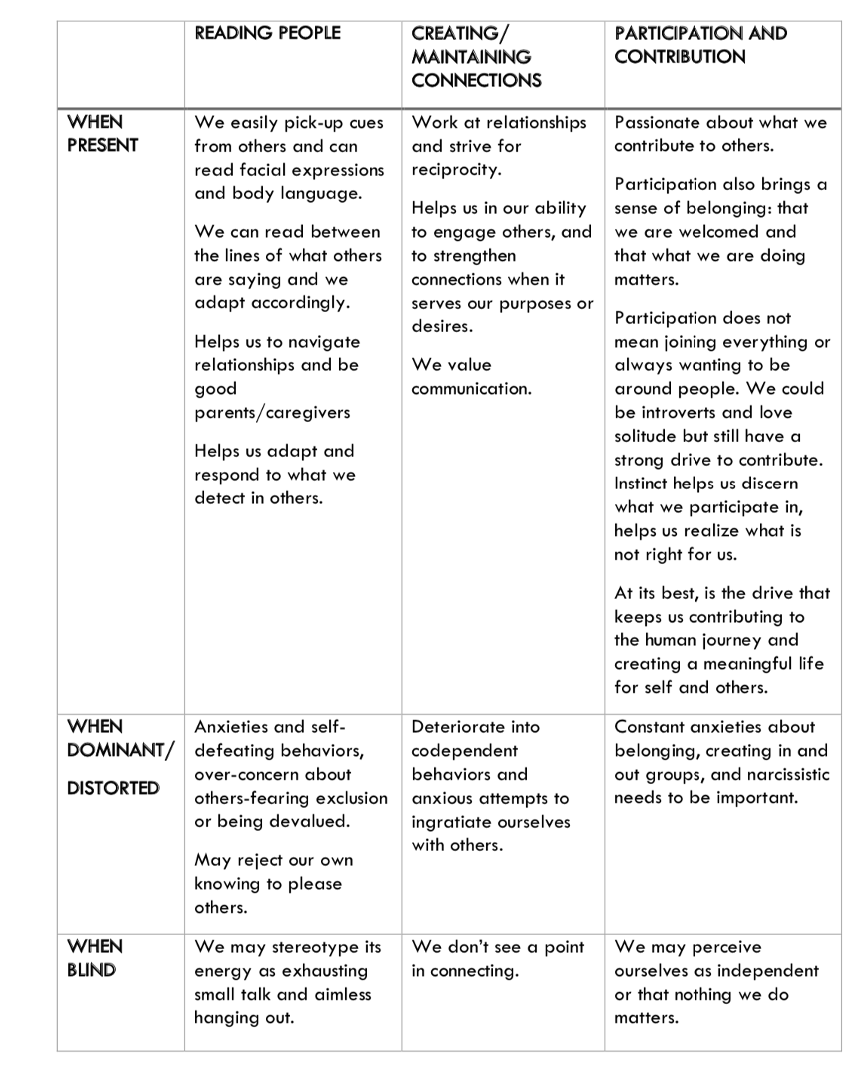
“Present” means in balance, healthy.
Where do you see yourself?
If you recognise more of yourself in the Dominant, that tells you that your relationship with the Social instinct is traumatised in some way.
If blind, it means that another instinct is stealing all the energy.
Maybe SX (Read about SX here), or SP (Read about SP here)
Going deeper: How does the SO Instinct get distorted?
In short: Trauma
The Social Instinct is all about basic human survival based on our very earliest need to be held and cared for by others. As early as minute one of our lives we cry in reaction to our disconnection. It is a matter of life and death, and this reliance on others as a basic survival imperative continues far beyond the early dependency levels of most other mammals. Years!
Our early holding environment begins even before birth to define our felt sense and mental models and assumptions about what human belonging looks like and what the conditions of connection are. We innately know that we need to be a valued member of the tribe, one way our another, and we figure it out by watching and testing what works and doesn’t work in tiny increments, with Big T and micro-traumas like punishment, rejection and abandonment signalling what we daren’t feel or do again.
If these things occurred in childhood, we become super wired to anticipate and pre-emptively defend against them as adults.
Having a Social Instinct helps us to mitigate against the real survival risks of social rejection, interpersonal violation or the deprivation of care, but also sets us up for locking parts of ourselves away, never to see the light of day, and shame is the prison guard.
SOCIAL Dominant Subtypes.
So what about The Social Instinct in the different Enneagram Types?
Each Type within the Enneagram has a distinct social subtype, characterized by specific preoccupations and tendencies within the social domain. The way in which each Type filters and seeks to fulfil the SO instinct varies significantly.
SO Eights want Invulnerability. SO Sevens want applause. SO Threes want prestige and admiration…
There is a cool poster that will help you compare Subtypes to be found here (my Learnworlds site). Screenshot below. You will have to zoom in to see it properly. It is nice to have it printed out big as a cheat sheet. My students love it. There are lots of other posters for download on the same page when you sign in as a free member.

Enjoy, and please join us at our bi-monthly gatherings!
Free of charge, all welcome!
2nd Tuesdays 19:00-21:00 SAST (Central Africa Time):
Wisdom of the Enneagram gatherings.
Diarise: https://calendly.com/takdir-ingrid-hurwitz/wisdom
Last Saturdays 16:00-18:00 SAST:
Enneagram Community of Practice
Diarise: https://calendly.com/takdir-ingrid-hurwitz/enneagram-community-of-practice
Deeper professional Enneagram application learning opportunities
And some upcoming training programmes for coaches, facilitators, psychotherapists, social workers, helpers and healers of all kinds:
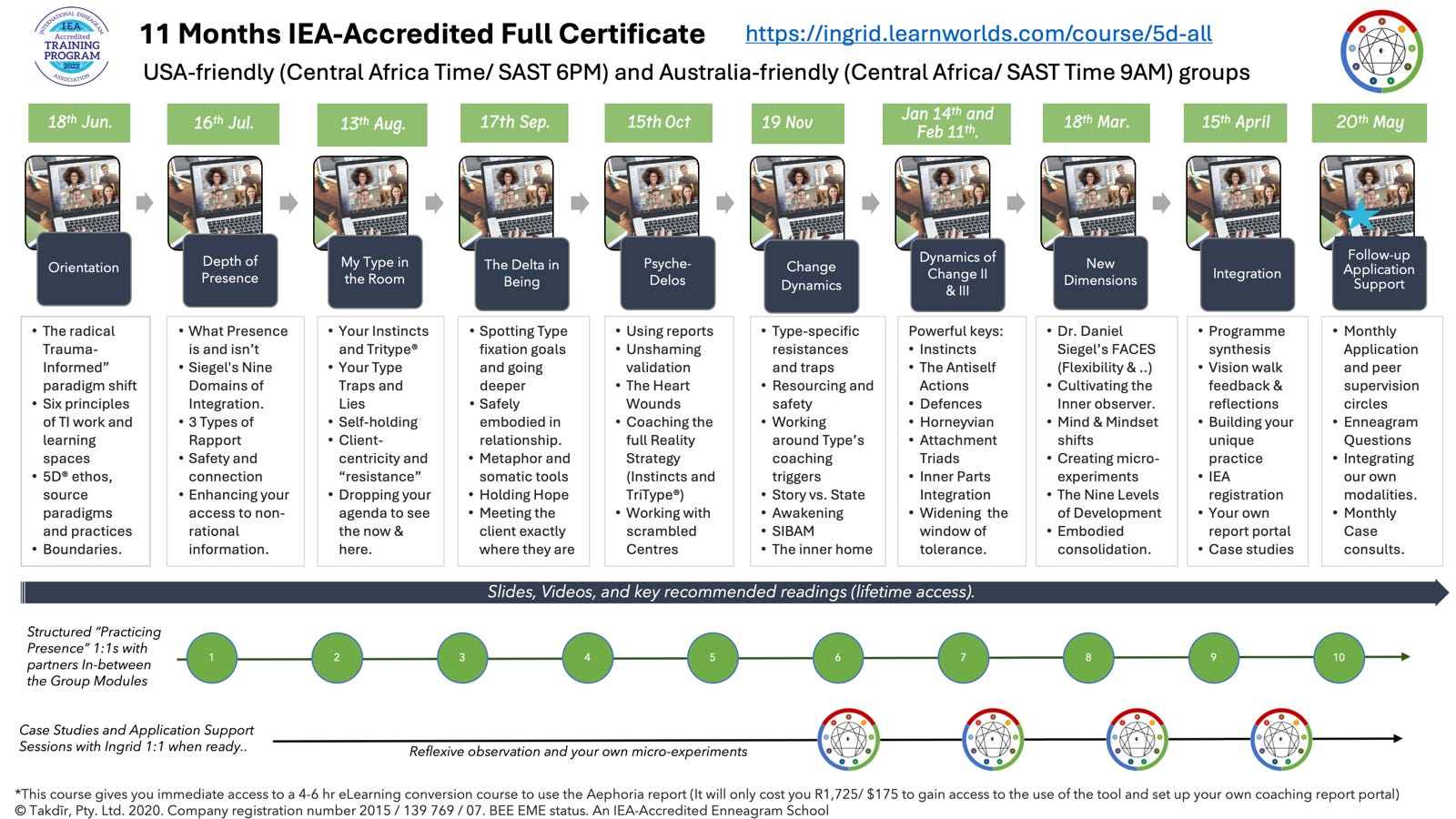
5D® Trauma-Informed Enneagram Coach Accreditation
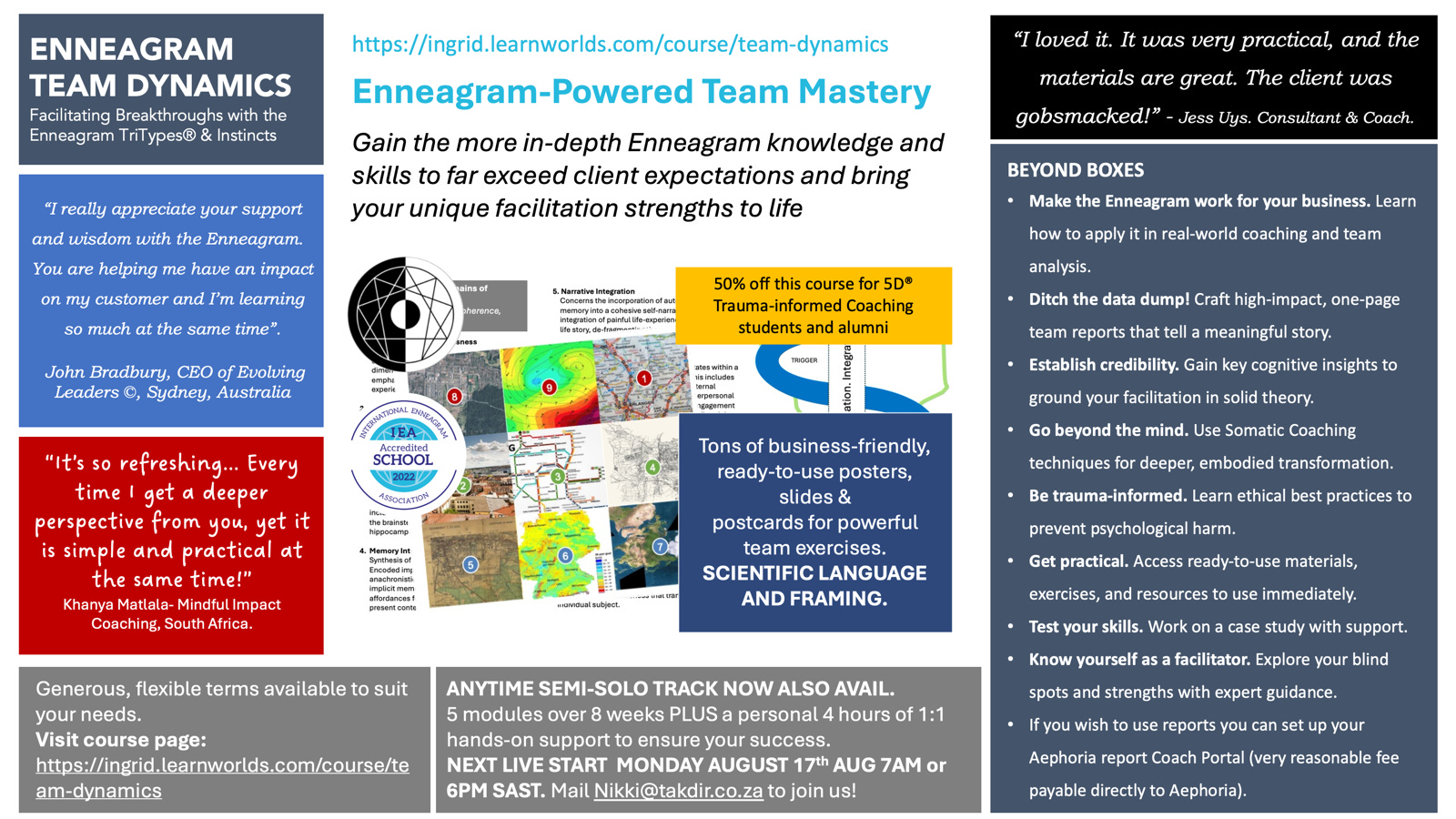
Team Dynamics Facilitation
Chat to Ingrid / Course Chemistry connect: 30 min
Love and blessings.
My favourite:
🪷
“I am grateful for this new day.
I embrace impermanence.
I cultivate compassion for myself and others.
I walk the path of Wisdom.
I am at peace with myself.”
🪷